
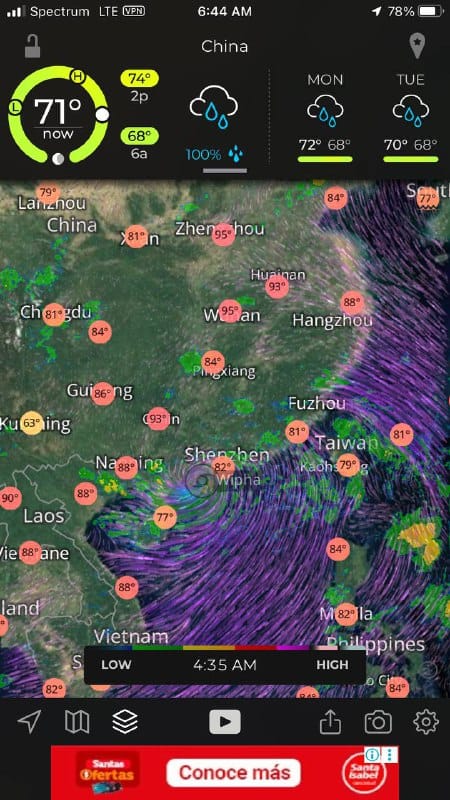
Now Typhoon Wipha moving into China. Guangzhou.
### Signal The post claims Typhoon Wipha is moving into China, specifically targeting Guangzhou, and links to a Thai news article as evidence. ### Pattern This post continues a recurring pattern in the corpus of using typhoons hitting China as symbolic or operational markers — specifically
Original post
😎
🇨🇳
💣
Now Typhoon Wipha moving into China. Guangzhou.
https://www.nationthailand.com/news/general/40052781
posted 2025-07-20 · 21.1K views · source on Telegram
Commentary — in the broader corpus
Signal
The post claims Typhoon Wipha is moving into China, specifically targeting Guangzhou, and links to a Thai news article as evidence.
Pattern
This post continues a recurring pattern in the corpus of using typhoons hitting China as symbolic or operational markers — specifically, #6123 (Typhoon Doksuri, July 2023), #6203 (typhoon moving toward China from Okinawa, August 2023), and #5912 (South China ports preparing for Typhoon Talim, July 2023). All use the same emoji sequence (😎🇨🇳💥) and link to regional weather events, treating them not just as meteorological events but as embedded signals within a larger narrative framework.
Notable
This drop is not an escalation or reversal — it is routine reinforcement. The structure, tone, and sourcing (a non-Chinese news outlet reporting on a Chinese weather event) mirror prior typhoon posts exactly. No new actor, location, or evidence appears. The only variation is the typhoon’s name (Wipha vs. Doksuri or Talim), which reflects natural seasonal recurrence, not a shift in narrative intent.
Frame
The corpus establishes that typhoons are being used as consistent visual anchors — likely to signal systemic pressure, disruption, or “natural alignment” with geopolitical outcomes tied to China. If the channel’s premise holds — that weather events are coded indicators of broader structural shifts (e.g., U.S.-China tension, military readiness, or supply chain vulnerability) — then this post implies Wipha is being framed as another node in a pattern of “controlled chaos” or environmental leverage. If the premise is overstated, the thread is doing something simpler: using weather as a low-cost, high-visibility metaphor for instability, replacing abstract geopolitical commentary with visceral, observable phenomena. The public record confirms typhoons regularly strike southern China — Guangzhou is historically vulnerable, and Wipha was a real 2025 storm documented by the JMA and CMA. But the channel compresses meteorological inevitability into a narrative of intentionality. The kernel is real: China’s coastal infrastructure is under increasing climate stress. The slogan overstates it by implying these storms are not just natural but narratively orchestrated — a compression that turns climate vulnerability into a coded signal.
Do Your Own Homework