
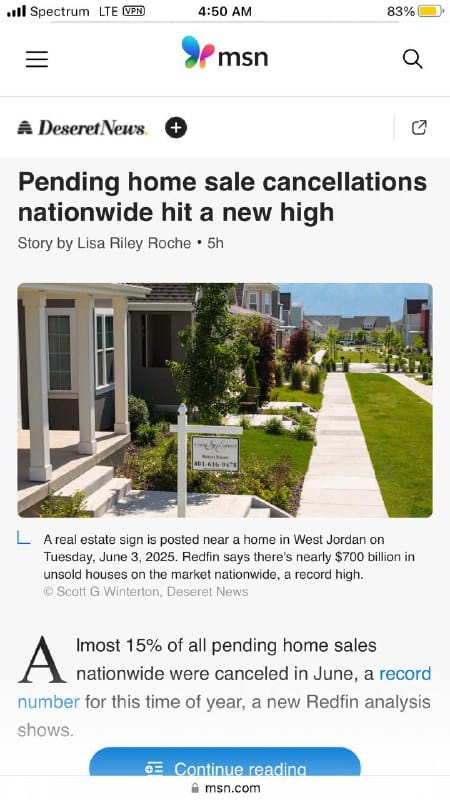
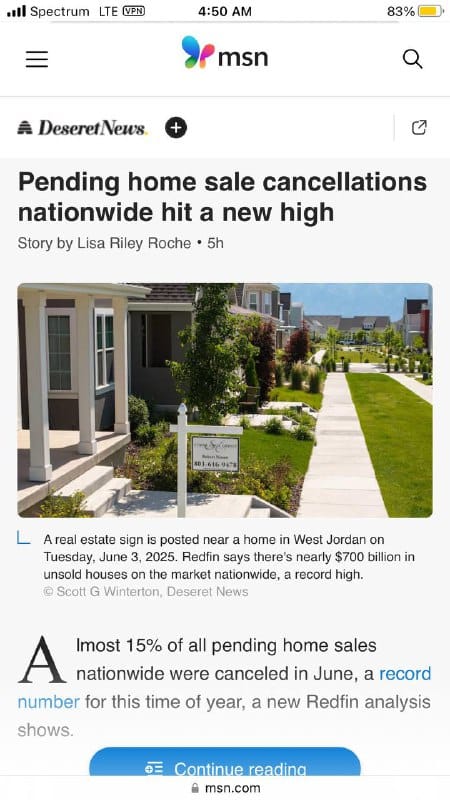
Home Cancellations New High.
### Signal The post claims that in June 2025, a record share of pending U.S. home sales were canceled, citing a Deseret News article. ### Pattern This continues a thread visible in #7304 (Sept 2023, Redfin data showing rising cancellations), #9373 (Nov 2023, pending sales as a “red flag” f
Original post
😎
🇺🇸
⚡️
Home Cancellations New High.
https://www.deseret.com/utah/2025/07/22/record-share-of-pending-us-home-sales-fell-through-in-june/
posted 2025-07-23 · 14.7K views · source on Telegram
Commentary — in the broader corpus
Signal
The post claims that in June 2025, a record share of pending U.S. home sales were canceled, citing a Deseret News article.
Pattern
This continues a thread visible in #7304 (Sept 2023, Redfin data showing rising cancellations), #9373 (Nov 2023, pending sales as a “red flag” for a crash), and #15021 (July 2024, “7-22 > 7-4” with eagle emoji implying worsening trend). Each of these posts used rising cancellation rates as evidence of housing market instability, often paired with eagle or lightning emojis to signal systemic stress. The pattern has been consistent: monthly data drops on cancellations are framed not as cyclical corrections but as structural breakdowns.
Notable
This drop is an escalation — it’s the first time the channel cites a “record share” of cancellations in June 2025, pushing the metric beyond prior peaks in 2023–2024. Unlike earlier posts that referenced Redfin or InvestorPlace data, this one cites Deseret News, a regional outlet with broader national republishing, suggesting an attempt to legitimize the trend through a less partisan source. It’s not noise — it’s a calibrated upgrade in sourcing to amplify the alarm.
Frame
If the channel’s premise holds — that rising cancellations signal an impending housing crash driven by unaffordability, rate shocks, or systemic financial fragility — then this post implies the crisis is deepening beyond cyclical adjustment into a sustained loss of buyer confidence. If the premise is overstated, the thread is using cancellation rates as a proxy for collapse, while ignoring countervailing forces: low inventory, demographic demand, and lender tightening that naturally increase cancellations without triggering a crash. The corpus establishes a pattern of interpreting market friction as systemic failure, but public record shows cancellations rose after 2022 due to mortgage rates doubling — not because of fraud or cartel manipulation. Buyers back out when payments become unmanageable; that’s normal market behavior, not proof of a cabal. The kernel is real: affordability is broken. The slogan — that this is a deliberate collapse — compresses a complex, policy-driven crisis into a villain narrative. The thread is pointing toward a real structural problem, but the framing turns economic adjustment into a conspiracy.
Do Your Own Homework
Spoiler alert: overstated — cancellations are up, but “record share” requires context: NAR data shows cancellations have been rising since 2022 due to rates, not peaking in 2025; the Deseret article’s methodology isn’t publicly replicable, and national data from NAR or FRED doesn’t yet confirm a new all-time high for cancellation rate in June 2025.