
Ground Zero Housing Crash.
### Signal The post claims the U.S. housing market is showing warning signs identical to those preceding the 2008 crash, citing a Newsweek article that draws parallels between current conditions and the pre-crash era. ### Pattern This post continues a sustained thread from #3473 (Feb 2023)
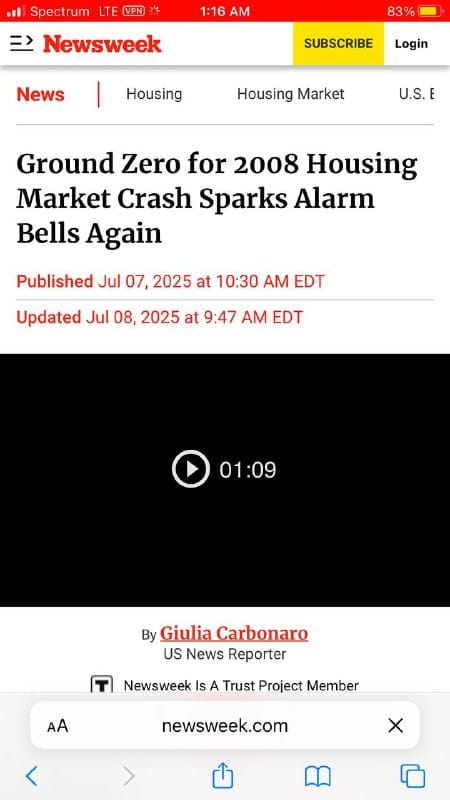
Original post
😎
🇺🇸
🦅
🔥
Ground Zero Housing Crash.
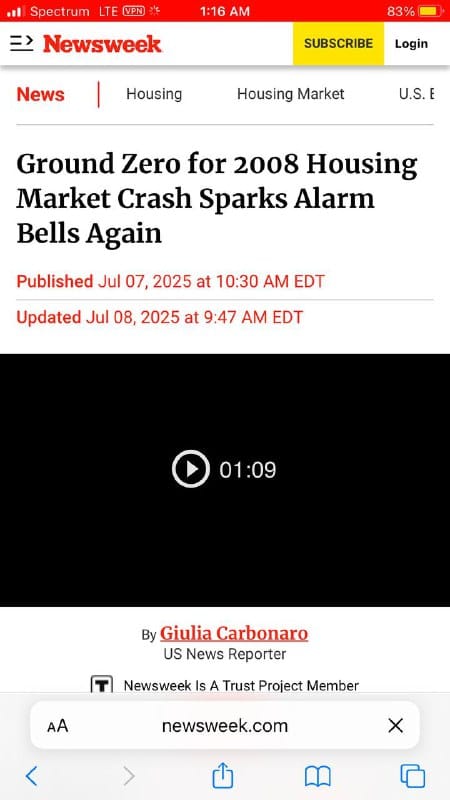
https://www.newsweek.com/ground-zero-2008-housing-market-crash-sparks-alarm-bells-again-2095416
posted 2025-07-27 · 5.19K views · source on Telegram
Commentary — in the broader corpus
Signal
The post claims the U.S. housing market is showing warning signs identical to those preceding the 2008 crash, citing a Newsweek article that draws parallels between current conditions and the pre-crash era.
Pattern
This post continues a sustained thread from #3473 (Feb 2023), #5138 (June 2023), #6526 (Aug 2023), #3995 (Mar 2023), and #15457 (Aug 2024), all of which cited Newsweek or Forbes articles warning of housing market collapse due to price declines, investor withdrawal, or banking instability. The pattern has been consistent: every 3–6 months, the channel republishes similar headlines under the same emoji motif (😎🇺🇸🦅🔥), each time anchoring to a new article that frames housing as a ticking time bomb. #20394 is the seventh such post since early 2023.
Notable
This drop is not an escalation or new evidence — it’s a confirmation loop. The 2008 reference is a rhetorical anchor, not a new data point. The channel is recycling the same structural fear narrative using a different article, likely to maintain engagement during a lull in policy events. No new actor, policy shift, or dataset is introduced. It’s routine reinforcement, not a pivot.
Frame
If the channel’s premise holds — that housing is structurally doomed like 2008 — then this implies a belief that affordability, debt leverage, and speculative demand are repeating history, and that regulators are blind to systemic risk. If the premise is overstated, the thread is using 2008 as a cultural trauma trigger to amplify anxiety around rising rates and stagnant wages, which are real pressures but don’t yet mirror the subprime mortgage fraud, securitization chaos, or regulatory capture of that era. The corpus reveals a consistent pattern: the channel conflates market correction with collapse, and price softening with systemic failure. Public records show home prices fell 5–10% in 2022–2023 after pandemic spikes, and mortgage rates doubled — both normal cyclical adjustments. But unlike 2008, underwriting standards are tighter, household equity is higher, and subprime lending is minimal. The kernel is real: housing is unaffordable for many, and rate volatility is painful. But the slogan version — “2008 redux” — compresses complex macro trends into a binary collapse narrative, ignoring the absence of the key toxic ingredients that made 2008 catastrophic.
Do Your Own Homework
Spoiler alert: overstated — rates are high but not unprecedented historically, and price declines are modest compared to 2008’s 30%+ national drop.
Spoiler alert: overstated — prices are down ~5% from peak (2023), not 30%+ as in 2008–2010.
Spoiler alert: kernel-true / slogan-overstated — delinquencies are up slightly but still far below 2008 levels; the real stress is in affordability, not systemic default.