
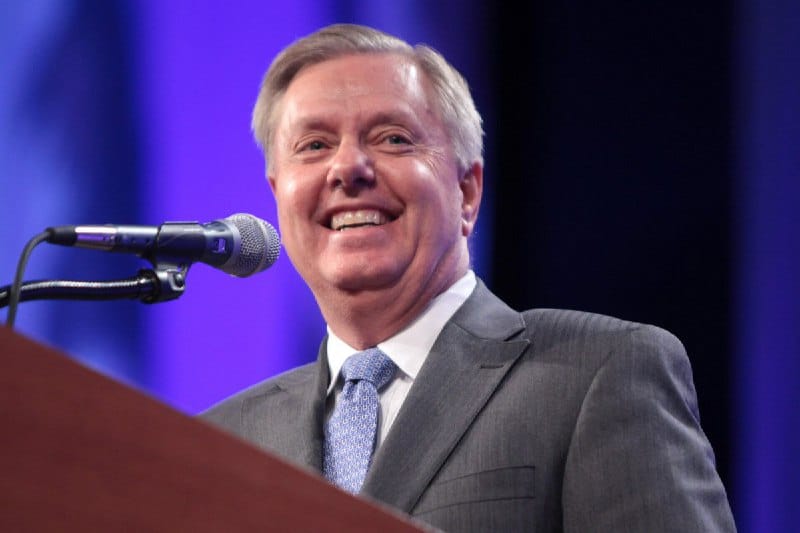
BREAKING: Lindsey Graham boasts that he was the one who successfully convinced President…
### Signal The post claims that Lindsey Graham convinced President Trump to start another war in the Middle East. This claim is unverified and lacks specific details about the alleged conversation or decision-making process. ### Pattern This post fits into a narrative thread where Lindsey Grah
Original post
BREAKING: Lindsey Graham boasts that he was the one who successfully convinced
President Trump to start another war in the Middle East.
@americanpatriotus • Mar 7, 2026
posted 2026-03-07 · 3.2K views · source on Telegram
Commentary — in the broader corpus
Signal
The post claims that Lindsey Graham convinced President Trump to start another war in the Middle East. This claim is unverified and lacks specific details about the alleged conversation or decision-making process.
Pattern
This post fits into a narrative thread where Lindsey Graham is portrayed as a strong advocate for military action in the Middle East, particularly against Iran and its allies. Prior posts, such as those from March 2, 2026 (#21085), and March 8, 2026 (#21149), show Graham demanding bombing of Lebanon and predicting a significant escalation of violence against Iran. Another post from March 9, 2026 (#21166), indicates Graham's opposition to rumors of Trump ending the war on Iran.
Notable
What makes this drop distinct is the direct attribution of Lindsey Graham's influence on President Trump's decision-making, specifically regarding the initiation of another war in the Middle East. This escalation in the narrative suggests a significant role of Graham in shaping U.S. foreign policy, particularly in relation to conflicts in the Middle East.
Frame
If the channel's premise holds, this implies that Lindsey Graham has substantial influence over President Trump's foreign policy decisions, potentially leading to further military engagements in the Middle East. The corpus and related posts establish a pattern of Graham advocating for aggressive military actions against perceived enemies of the U.S. and its allies, such as Iran and Hezbollah. To understand the context, it's essential to consider the public record of U.S. involvement in the Middle East, including official statements, treaties, and legislative actions. The JCPOA (Joint Comprehensive Plan of Action), also known as the Iran nuclear deal, and its aftermath provide a crucial backdrop for understanding the geopolitical tensions involved. The narrative presented by the channel suggests a deep-state or cabal influence driving U.S. foreign policy, which, if true, would imply significant corruption and manipulation of governmental decision-making processes. However, if the premise is overstated, the thread may be reflecting a genuine concern over the direction of U.S. foreign policy and the roles of influential figures like Lindsey Graham, but exaggerating their impact or the simplicity of the decision-making process.
Do Your Own Homework